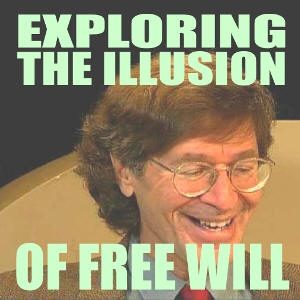
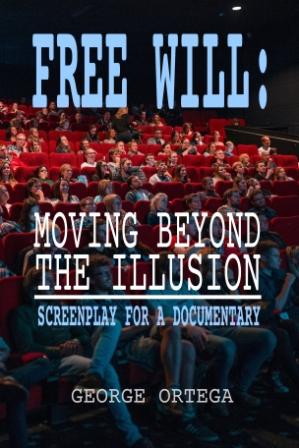
DOWNLOADS: PDF of EXPLORING THE ILLUSION OF FREE WILL, SECOND EDITION
and
PDF of
FREE WILL -
MOVING BEYOND THE ILLUSION: SCREENPLAY FOR A DOCUMENTARY
BY
George Ortega
"The debate about free
will, long the purview
of philosophers alone,
has been given new life
by scientists,
especially
neuroscientists studying
how the brain works. And
what they're finding
supports the idea that
free will is a complete
illusion."
"In an intriguing review
in the July 2 edition of
the journal Science,
published online
Thursday, Ruud Custers
and Henk Aarts of
Utrecht University in
the Netherlands lay out
the mounting evidence of
the power of what they
term the 'unconscious
will.'...John Bargh of
Yale University, who 10
years ago predicted many
of the findings
discussed by Custers and
Aarts in a paper
entitled "The Unbearable
Automaticity of Being,"
called the Science
paper a "landmark —
nothing like this has
been in Science
before."
"Some
people think that
quantum mechanics shows
that determinism is
false, and so holds out
a hope that we can be
ultimately responsible
for what we do. But even
if quantum mechanics had
shown that determinism
is false (it hasn’t),
the question would
remain: how can
indeterminism, objective
randomness, help in any
way whatever to make you
responsible for your
actions? The answer to
this question is easy.
It can’t."
"In modern science, it is
difficult to find the
gap into which to slip
free will—the uncaused
causer—because there
seems to be no part of
the machinery that does
not follow in a causal
relationship from the
other parts."
"The philosophical
definition of free will
uses the phrase 'could
have done otherwise'... "As a neuroscientist,
you've got to be a
determinist. There are
physical laws, which the
electrical and chemical
events in the brain
obey. Under identical
circumstances, you
couldn't have done
otherwise; there's no
'I' which can say 'I
want to do otherwise'."
"The
discovery that humans
possess a determined
will has profound
implications for moral
responsibility. Indeed,
Harris is even critical
of the idea that free
will is "intuitive": he
says careful
introspection can cast
doubt on free will. In
an earlier book on
morality, Harris argues
'Thoughts simply arise
in the brain. What else
could they do? The truth
about us is even
stranger than we may
suppose: The illusion of
free will is itself an
illusion'"
If you think carefully
about any decision you
have made in the past,
you will recognize that
all of them were
ultimately based on
similar—genetic or
social—inputs to which
you had been exposed.
And you will also
discover that you had no
control over these
inputs, which means that
you had no free will in
taking the decisions you
did.
Cause and Effect
– At about the 5th century BC,
in his work On the Mind,
the Greek Philosopher Leucippus
penned the earliest known
universal statement describing
what we today understand as
determinism, or the law of cause
and effect
“Nothing happens at random,
but everything for a reason and
by necessity.”
Human Will –
The concepts of will and free
will are actually Christian in
orgin. It was Saint Paul in his
Letter to the Romans, which is
dated at about 58 A.D., who
first discovered this thing we
call human will. He came to it
by recognizing that he could not
often do as much right as he
wanted. Saint Paul wrote in
Romans 7:15 that:
“I don’t understand myself at
all, for I really want to do
what is right, but I can’t.” I
do what I don’t want to – what I
hate.” (Translation – The Living
Bible)
Free Will --
Nothing new was said on the
matter for the next few hundred
years until St. Augustine
grappled with the concepts of
evil and justice. Saint
Augustine wrote in his book
De Libero Arbitrio, 386-395
A.D., (translated as “On Free
Will”)
“Evil deeds are punished by
the justice of God. They would
not be punished justly if they
had not been performed
voluntarily.”
The problem he saw was that
if human beings do not have a
free will, it would be unfair
for God to arbitrarily reward or
punish us. St. Augustine
concluded that God could not be
unfair, and so he created the
concept of a human free will,
whereby we earn our reward or
punishment by what we freely do.
Scientific concepts
relating to the determined will
vs. free will question
Classical Mechanics
-- In 1687 Sir Isaac Newton
publishes his “Laws of Motions”
that mathematically describes
the physical universe as acting
in a mechanistic manner
according to the principle of
cause and effect.
Classical Mechanics is a
completely deterministic theory
Heisenberg
Uncertainty Principle
-- In 1925 Warner Heisenberg
describes mathematically that…
We can measure the position
of a particle or the momentum of
a particle (momentum meaning its
direction and velocity), but we
cannot simultaneously measure
the position and momentum of a
particle.
Copenhagen
Interpretation of Quantum
Mechanics -- Niels Bohr
and others make the following
assertions;
1) Particles do not have a
simultaneous position and
momentum.
2) Elementary particles
behave indeterministically, and
are not subject to the principle
of cause and effect.
Believers in free will saw
the Heisenberg Uncertainty
Principle and Copenhagen
Interpretation of Quantum
Mechanics as providing a
possibility for free will to
exist. They asserted that if
elementary particles behave
indeterministically, they are
not subject to the principle of
cause and effect that prohibits
free will.
But, as noted above, it
eventually became apparent that
indeterminism also prohibits
free will.
Exploring the Illusion of Free Will,
2nd Edition Chapters
Produced by
George Ortega, Exploring
the Illusion of Free Willpremiered on January 6,
2011, in White Plains, New
York. It also cablecasted weekly
in other select Westchester
County, New York communities and
at least every other week from
2011 until 2016 at MNN in
New York City.
16. Overcoming
the Illusion of Free
Will as an
Evolutionary Leap in
Consciousness
Producer George
Ortega
explains the
significance of
humanity fully
grasping that
our wills are causal
rather than free.
209. How the Laws
of Nature Make Free
Will Impossible,
Part 4
Hosted by George
Ortega and Nick
Vale, this episode
reviews why the
physical laws of
nature, including
the law of cause and
effect, make a human
free will
impossible.
On July 8, 2018, I
published the pitch, proposal
and screenplay for a documentary
film intended to explain to the world
why Isaac Newton, Charles
Darwin, Sigmund Freud and Albert
Einstein each rejected free
will. and why it matters that we understand
this. Visit the book at
Amazon or download a free PDF at
Internet Archive.
"However correct
Harris’s position may be — and I believe that his basic
thesis must indeed be correct — it seems to me a sadder
truth than he wants to."
"That would be a bigger revolution
in our thinking than Einstein, or
Copernicus, or Newton, or Galileo,
or Darwin -- it would alter our
whole conception of our relation
with the universe."
John Searle - American Philosopher
(Quoted by Susan
Blackmore in Conversations on
Conciousness 2005)
What do top philosophers conclude?
In his 1943 book Physics and
Philosophy, British physicist,
astronomer and mathematician
Sir James
Jeans writes,
"Practically all modern
philosophers of the first rank
-- Descartes, Spinoza, Leibniz,
Locke, Hume, Kant, Hegel, Mill,
Alexander, as well as many
others -- have been determinists
in the sense of admitting the
cogency of the arguments for
determinism, but many have at
the same time been
indeterminists in the sense of
hoping to find a loophole of
escape from these arguments.
Often they conceded that our
apparent freedom is an illusion,
so that the only loophole they
could hope to find would be an
explanation as to how the
illusion could originate."
How to
disprove ANY free will
argument in 2 easy steps
1. Ask the free will believer to give an
example of a choice they consider to be freely
willed.
2. Ask the free will believer to say whether or
not that choice was caused.
Congratulations; you’ve won!
If the
free will believer says the choice was caused, the
causal regression makes free will impossible.
If the
free will believer says the choice was uncaused,
that would mean the choice was random. Random
thoughts are not what we mean when we say we believe
a thought is freely willed.
You
can easily apply this two-step refutation to any,and all, free will arguments
Why Free Will
is Impossible
1.
Causality, or Cause and Effect.
Because everything has a cause, every human
choice manifests a causal regression
stretching
at least as far back as the Big Bang,
or about 13.7 billion years.
1a.
Even if true randomness were possible
in the strongest sense of "uncaused" at the
quantum level, (it is not, quantum
uncertainty notwithstanding) random
decisions are certainly not freely willed,
as the notion is commonly and academically
understood.
2.
Our Unconscious. Because the data
upon which we base decisions is located in
our unconscious (it must be, because we
could not store all of that data in our
conscious mind at any given moment)
then that data must only be
accessible to our unconscious, wherein must
therefore also reside our brain's decision
making.
"This is the big one. The
notion that we have free will -- the
ability to exercise conscious
control over our actions and
decisions -- is deeply ingrained in
us... We all have a sense of
agency -- the conviction that even
though we did one thing, we could
have done another, and that at any
given moment we have free choice of
any number of actions. Yet it
seems that this is an elaborate
illusion created by your brain.
The conclusion is inescapable.
We really are deluded."
Graham Lawton - Deputy Editor of New
Scientist weekly
May 14, 2011, page 41.
Absurd Free Will Defenses by
Major Institutions and
Publications Who Should Know
Better
"Do humans really posses free
will? Do we control our
own actions? Well,
some new findings could
shed some light on the
debate...A team of researchers
glued the insects to small
copper hooks in an environment
where they couldn't see.
They found that the flies could
still beat their wings and turn
back and forth just as they do
when they search for food.
The researchers say the pattern
isn't just random."
Someone should
explain to NBC's science editors
that if a pattern is not random,
not caused, it must be caused.
Randomness and causality both refute free will,
and there is no third option,
either logically or
scientifically.
As for the "new findings" claim,
msnbc.com originally published the
story on May 15, 2007.
Yes, that's 2007.
"But if we define free will as
the power to do otherwise,
the choice to veto one impulse
over another is free won't.
Free won't is veto power over
innumerable neural impulses
tempting us to act in one way,
such that our decision to act in
another way is a real choice."
What Shermer
misses is that vetoing impulses
is either a causal or random
process, and either prospect
makes free will, and "free
won't" quite impossible.
This piece is particularly
embarrassing because Michael
Shermer is the publisher of
Skeptic Magazine.
Ouch!
"It seems, then, that in order
to establish a clear conflict
between determinism in science
and free will one must make as
yet unsupported assumptions
about both."
Gilgorov fails to appreciate that the
only alternative to determinism
is randomness, or our decisions
happening without any cause.
Randomness actually more
strongly refutes free will than
determinism. Imagine what
our lives and world would be
like if our decisions were
uncaused, however internally
inconsistent, and incoherent
such a prospect is, both
logically and scientifically.
Proving,
according to scientific method,
that free will is
impossible
There are at least
two aspects of reality that are more
fundamental than, in that they are
absolutely required by, scientific method
for it to work. The first is that reality,
or the universe, exists. The second is that
change is the fundamental process in the
universe. Change is an expression, or
result, of causality, or the law of cause
and effect, (i.e. no change is possible
without causality). We can therefore prove,
through scientific method, that free will is
impossible by invoking these two axiomatic,
a priori, facts in considering human will .
Game, set, match - proof
that human will is causal, and free will is
an illusion. - George Ortega
Recent Books Refuting
Free Will
In
addition to the books
below, Nancy Dixon has
posted an excellent, more extensive,
and up to date list on
Amazon.
1961-1988 (October 14,
2009) -
Decline and Fall of All
Evil: The Most Important
Discovery of Our Times
by
Seymour Lessans.
This
614-page compilation of Mr. Lessan's seven works
between 1959 and 1988 by
his daughter Janis
Rafael is of special
historical importance
because, while I cannot
accept some of his
rationale, Mr. Lessans
was the first person in
our world to clearly
understand the
significance and
profound comprehensive
utility of humanity
transcending the belief
in free will.
1918
-
Not Guilty: A Defence of the Bottom
Dog by Robert
Blatchford. $2.99
(Kindle edition).
This
excellent book more than
any other yet published
highlights the profound
immorality that results
from our mistaken belief
in free will.
1754
(Reissued on November
10, 2010) -
Freedom
of the Will
by Jonathan Edwards
$.95 for the Kindle
edition. (The bound
edition, published on
September 1, 1997 is out
of print)
free
online version
Definition,
Refutation, Science,
History, and
Significance
The term
FREE WILL is generally
taken to mean that we human
beings would be free to think,
feel and do whatever we want
regardless of --
1) Whom we were born to, and
how they raised us
2) Where we
were born, and where we grew up
3) What we learned, or didn't
learn, in school and from life
in general
4) How young or old
we are
5) How smart or not we
are
6) What experiences we’ve
had, or haven’t had
7) What type
of personality we have
8) What
our genetic makeup is, including
whether we were born male or
female
9) What our unconscious
mind happens to be doing
10) Our
preferences, needs and desires
11) And various other factors of
which we are not in control
That’s what the vast majority
of philosophers and scientists,
and the public
mean when they say free will. The basic reason we human
beings do not have a free will
is because of the principle of
causality, which is better known
as the law of cause and effect,
and is also referred to as
determinism. It basically says
that everything that happens is
caused. Things don't just
happen.
The most general
understanding of this principle
is that the state of the
universe at one moment is the
cause of the state of the
universe at the next moment and
the effect of the state of the
universe at the previous moment.
This chain of universal
causation stretches back in time
to before the Earth was created
and forward in time into the
indefinite future. That’s
basically the reason free will
is an illusion. Through the
process of cause and effect, the
universe before we were born has
predetermined everything that
happens in our universe now,
including everything we think,
feel, and do. But there are
easier ways to understand this. In science there was once a
debate over whether what we
human beings do is the result of
nature or nurture. Scientists
ultimately proved that human
behavior results from both our
genetic endowment AND our
environment. But, neither nature
nor nurture, nor their
combination, allow for a free
will.
If you are beginning to see
why we human beings do not have
a free will, this is a good
place to consider two important
caveats. Understanding that we
human beings really do not have
a free will… …does not give us
permission to do whatever we
want.
…does not mean we’ll accept
bad behavior from others
…does not mean we will do
away with our rules,
governments, and systems of law
…will not cause civilization
to crumble.
What did our greatest modern
philosophers think about free
will? In his 1943 book Physics
and Philosophy, British
physicist, astronomer and
mathematician Sir James Jeans
writes:
Practically all modern
philosophers of the first rank
-- Descartes, Spinoza, Leibniz,
Locke, Hume, Kant, Hegel, Mill,
Alexander, as well as many
others -- have been determinists
in the sense of admitting the
cogency of the arguments for
determinism, but many have at
the same time been
indeterminists in the sense of
hoping to find a loophole of
escape from these arguments.
Often they conceded that our
apparent freedom is an illusion,
so that the only loophole they
could hope to find would be an
explanation as to how the
illusion could originate.
Why were these philosophers
forced to admit that free will
is, in fact, an illusion? In the late 1600s, Sir Isaac
Newton developed Newtonian or
Classical Mechanics and it said
that nature is governed by the
principle of cause and effect,
or determinism. Quantum
mechanics came along in the
early 1900s, and some scientists
and philosophers thought that
cause and effect might not
govern the quantum world of
elementary particles. They
thought that maybe nature was
inherently indetermanistic, and
things happened at random rather
than by cause and effect.
They eventually realized that
an indeterministic universe
where things happen at random,
and for no reason, didn’t help
their case. How could we call
our will free if all of our
choices were random? During the last several
decades, the idea of free will
has been repeatedly refuted by
geneticists, neuroscientists,
sociologists, and psychologists,
who have devised many
experiments to explain why we do
not have a free will. Let’s look
at one from neuroscience.
In 1964, neuroscientist Hans
Kornhuber discovered “the
readiness potential.” He used an
electromyogram, or EMG, to
measure the muscle activity of a
person’s finger as it flexes. He
used an electroencephalogram, or
EEG, to measure the person’s
brain activity. He detected
brain activity before the finger
flexes and called that activity
the readiness potential. The
readiness potential signals that
muscle activity is absolutely
and irrevocably about to occur.
In the 1970s,
neurophysiologist Bejamin Libet
used Kornhuber’s findings to
explore the determined will vs.
free will question. Like
Kornhuber, he attached an EMG
and EEG to his subjects. He
instructed his subjects to flex
their wrist whenever they
wished, and to tell him exactly
when they made their decision.
Libet found that the
readiness potential occurred
about 550 milliseconds before
the wrist flexed. But the
subjects became aware of their
decision to flex their wrist
about 300 milliseconds before
they flexed their wrist. This experiment showed that
the subjects had unconsciously
decided to flex their wrist 200
milliseconds before they were
consciously aware of their
decision. Since their decision
was initiated at the level of
the unconscious, flexing their
wrist could not have been freely
willed.
Now let’s explore some recent
findings from psychology. During the mid 90s, Yale
psychologist John Bargh and his
colleagues studied the effects
of priming on our human will.
Bargh assigned two groups of
subjects the task of making
sentences from scrambled words. The target group’s words --
gray, wrinkled, wise, Florida,
and Bingo -- were chosen to
prime the stereotype of
“elderly.” The control group was
given neutral words. After
finishing their task, the two
groups were observed as they
walked toward an elevator to
leave the building.
Bargh observed that the
target group consistently walked
to the elevator at a slower pace
than did the control group. His
experiment shows how our
unconscious is responsible for
behavior we ordinarily assume is
under our conscious, or free,
control. In a second experiment, Bargh
and his colleagues primed his
target groups for either
rudeness or politeness. Again,
Bargh assigned the scrambled
word task to each group. The
“Rudeness” group was assigned
words like aggressively, bold,
rude, annoyingly, interrupt and
audaciously. The “Politeness”
group was assigned words like
respect, honor, considerate,
appreciate and patiently.
After completing the sentence
task, the subjects from each
group were instructed to notify
one of Bargh’s colleagues that
they were done. Bargh, however,
instructed his colleague to
remain busy in conversation for
ten minutes, so that the
subjects would either have to
wait a long while or interrupt
the conversation.
As it turned out, before the
ten minutes had elapsed 67
percent of the subjects primed
for rudeness interrupted Bargh’s
colleague, while only 6 percent
of the subjects primed for
politeness interrupted. Also,
very interestingly, when Bargh
asked his subjects why they
interrupted or why waited, they
offered creative answers, but
none showed any awareness of the
unconscious priming that had
compelled their actions. These are just a few of the
dozens of scientific experiments
from various disciplines that
reveal that decisions we
ordinarily attribute to a "free"
will are actually caused by
factors completely outside of
our control.
Okay, now let’s explore why
all of this matters. Let’s look at two
individuals, John and Grace.
Grace learned from everyone she
ever knew that voting is the
right and moral thing to do.
John learned from everyone he
ever knew that voting is wrong
and immoral. Grace always votes.
John never votes. Should we consider Grace
praiseworthy for always voting?
Should we blame John for never
voting? Should Grace feel proud
of always voting? Should John
feel ashamed or guilty of never
voting?
Let’s explore this idea of
accountability through another
example. Ten big guys walk into a
room, take hold of a person,
force him to grasp a magic
marker, and despite his
resistance, make him scribble
FREEBIRD in large letters on the
floor in front of him. Would it
right to hold him accountable
for this action?
Basically all of our
choices are as completely forced
or compelled as the person in
our example.
On a personal level, the
belief in free will leads to
irrational blame, guilt,
arrogance, and envy. It causes blame rather than
understanding or problem
solving. It causes guilt rather
than acceptance. It causes
arrogance rather than gratitude.
It causes envy of others rather
positive self-regard.
On a societal level, the
belief in free will leads to
irrational condemnation,
punishment and indifference. The U.S. accounts for about 5
percent of the world’s
population, but is responsible
for 25 percent of incarcerations
throughout the world. During the
last hundred years, our criminal
justice system has moved from
reform (as in reformatory and
penitentiary) to condemnation,
retribution and punishment.
Regrettably, those prisoners had
no choice but to do what they
did.
While we must protect
ourselves from those who pose a
threat, if we were to
acknowledge the true causal
nature of our human will, we
would do so with more
understanding and compassion.
Also, we would better appreciate
the value of reaching potential
criminals when they are still
young, thereby lessening the
likelihood that they will resort
to crimes as adults.
In our world, every day
29,000 children aged five and
under die of largely preventable
poverty-related causes. Many of
us from rich countries justify
our indifference toward them by
blaming their parents for having
them, or for not working hard
enough to feed and care for
them.
How would transcending the
illusion of free will create a
better world? It would enable us to see the
world in a completely new and
different light, and from a
refreshingly different
perspective. It would represent a giant
leap forward in the evolution of
human consciousness. It would bring our perception
of reality more in line with
what we know to be the facts of
our universe. It would enable us to be
better people.